Best Orthopedic Surgeon In ChennaiAdvanced Bone & Joint Care for Every Stage of Life
An Orthopaedic Specialist In Chennai is a doctor trained to diagnose and treat conditions affecting the bones, joints, muscles, ligaments, tendons, and spine. These problems don't affect only the elderly — children, athletes, working professionals, and senior citizens can all experience bone and joint issues at different stages of life, from a growth-related deformity in a toddler to a sports injury in a young adult or arthritis in later years.
What tends to matter most, across all of these, is timing. Catch a problem in the first few weeks and it's usually a much simpler fix — less likely to need surgery, quicker to recover from. Let it sit for a year and the story changes. That's really the argument for finding the right orthopaedic specialist in Chennai early, before things get complicated.
Dr. Jeshwanth Netaji doesn't run on a fixed script. At Jeshwanth Orthopaedics, he builds every treatment plan around the person in front of him — how bad the pain actually is, what their job involves, how active they are, what they're hoping to get back to. For one patient that might mean a course of physiotherapy. For another it might mean surgery is genuinely the better call. Either way, it's a decision made together, and the aim is always the most appropriate treatment — not the biggest one.
Why Patients Choose Dr. Jeshwanth Netaji's Orthopaedic Hospital?

Experienced Orthopaedic Surgeon
Patients consistently describe Dr. Jeshwanth Netaji as the best orthopedist in Chennai for combining surgical skill with a genuinely patient-first approach.

Patient-Centred Care
Every consultation is built around listening first — understanding the patient's goals before recommending a plan.

Advanced Surgical Techniques
Modern, evidence-based surgical approaches for joint replacement, arthroscopy, and fracture fixation.
Evidence-Based Treatment
Treatment decisions are guided by current clinical evidence, not outdated or generic protocols.
Comprehensive Rehabilitation
Structured physiotherapy and rehabilitation support patients from surgery through full recovery.
Long-Term Follow-up
Ongoing follow-up ensures recovery stays on track and any concerns are addressed early. For these reasons, many patients across the city consider this clinic home to the best orthopedist in Chennai for both routine and complex orthopaedic care.
Why Choosing the Right Orthopaedic Specialist Matters?
Patients rarely walk in already wanting surgery. What they actually want is a doctor who understands:
- Their pain level and how it affects daily life
- Their daily activities and physical demands
- Their occupation and work requirements
- Their sports participation or fitness goals
- Their age and general health
- Their recovery goals and expectations
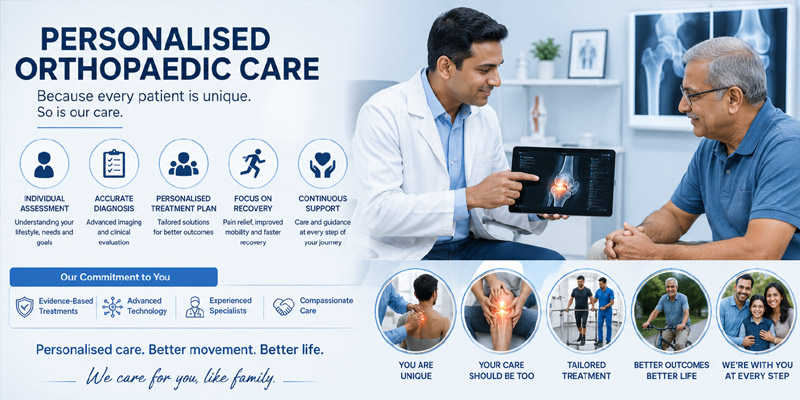
Individual Patient Assessment
Every patient has unique symptoms and functional limitations — two people with the same X-ray finding can have very different pain levels, mobility, and treatment needs. A proper assessment looks at the whole person, not just the scan.
Accurate Diagnosis
Treatment begins with identifying the exact cause of pain, not just naming the affected joint. This means understanding whether pain comes from arthritis, a ligament tear, cartilage damage, inflammation, or a completely different source, such as a spine issue presenting as joint pain.
Personalised Treatment Plan
Care is tailored to the patient's lifestyle and long-term health goals — a plan for a competitive athlete looks very different from a plan for a retiree managing early arthritis, even if the diagnosis is similar.
Comprehensive Orthopaedic Care Under One Roof
From the first consultation through diagnosis, treatment, and rehabilitation, patients receive complete orthopaedic care without being referred elsewhere for routine needs.
Knee Pain Treatment
- Arthritis
- Ligament injuries
- Meniscus tears
- Cartilage damage
Hip Pain Treatment
- Hip arthritis
- Labral injuries
- Avascular necrosis
- Hip replacement evaluation
Shoulder Treatment
- Rotator cuff tears
- Frozen shoulder
- Shoulder instability
- Arthritis
Sports Injury Management
- ACL injuries
- PCL injuries
- Meniscus tears
- Tendon injuries
- Arthroscopy
Fracture Care
- Trauma
- Complex fractures
- Bone healing
- Rehabilitation
Pediatric Orthopaedics
Children's bones and joints are still growing, which means orthopaedic problems in kids need a different diagnostic and treatment approach than in adults. As one of the trusted names for pediatric orthopaedic care, our Dr. Jeshwanth Netaji's addresses:
- Clubfoot
- Bow legs
- Knock knees
- Congenital deformities
- Growth plate injuries
Parents searching for the Best Pediatric Orthopedic Doctor In Chennai want reassurance as much as expertise — every pediatric consultation includes a clear explanation of the condition, a conservative-first approach wherever appropriate, and ongoing monitoring through the child's growth.
Conditions Commonly Treated by an Orthopaedic Specialist
- Knee arthritis
- Hip arthritis
- Osteoporosis
- Sports injuries
- Joint stiffness
- Frozen shoulder
- Tennis elbow
- Carpal tunnel syndrome
- Ligament tears
- Meniscus injuries
- Fractures
- Spine-related joint pain
- Tendon injuries
- Bone deformities
- Pediatric orthopaedic conditions
Advanced Diagnostic Approach
Diagnosis doesn't rely on scans alone. A combination of clinical judgment, imaging, and functional testing gives a far more accurate picture than imaging alone.
Detailed Clinical Examination
History taking, Physical examination, Range of motion assessment, and Pain assessment.
Modern Imaging Evaluation
X-rays, MRI, CT Scan, and Ultrasound (when required).
Functional Assessment
Walking pattern, Strength, Stability, Mobility, and Daily activities assessment.
Personalised Treatment Options
Once the diagnosis is clear, treatment is chosen from the full range of available options — starting conservatively wherever it's genuinely appropriate.
Non-Surgical Treatment
Medication, Physiotherapy, Lifestyle modification, Joint injections, Bracing, and Exercise programs.
Minimally Invasive Procedures
Arthroscopy, Joint preservation, and Ligament reconstruction.
Joint Replacement Surgery
When conservative treatment isn't enough, joint replacement can restore mobility and relieve pain reliably. This includes consulting an expert Knee Replacement Surgeon In Chennai for knee procedures, advanced hip replacement by a leading Hip Replacement Surgeon In Chennai, and revision replacement for previously operated joints. Dr. Jeshwanth Netaji considers every replacement around the patient's bone quality, activity goals, and overall health — not a one-size-fits-all protocol.
When Should You Visit an Orthopaedic Specialist In Chennai?
- Persistent joint pain
- Difficulty walking
- Sports injury
- Joint swelling
- Reduced movement
- Bone fracture
- Neck pain
- Back pain
- Shoulder pain
- Hip pain
- Knee pain
Why Personalised Orthopaedic Care Delivers Better Outcomes
Right Diagnosis
Treating the actual problem — not just the symptom — leads to treatment that actually works the first time.
Right Treatment
A personalised approach helps avoid unnecessary surgery, recommending the least invasive option that will genuinely solve the problem.
Faster Recovery
Individual rehabilitation plans, built around the patient's specific injury and goals, consistently produce faster, more complete recovery than generic protocols.
Long-Term Joint Health
Personalised care doesn't stop at symptom relief — it looks at preventing future complications and protecting joint health over the long term.
Looking for an Ortho Clinic Near Chromepet?
If you're in Chromepet, Pallavaram, Tambaram, GST Road, Hasthinapuram, Selaiyur, Medavakkam, or Velachery, you shouldn't have to cross the city for decent orthopaedic care. This ortho clinic in Chrompet offers the same depth of diagnosis and treatment you'd get at a major city hospital, just a lot more reachable for anyone in South Chennai.
If you've been searching for an ortho doctor near Chromepet Chennai, Dr. Jeshwanth Netaji's ortho clinic offers full consultation, diagnostic imaging coordination, and treatment planning close to home. And for patients specifically looking for the best orthopedist in Chrompet, the same AIIMS-trained expertise and personalised treatment philosophy used across all our services is available right here in your neighbourhood.
Whether it's routine follow-up or a more complex case, this ortho clinic in Chrompet is built to handle it locally.
Our Orthopaedic Treatment Process
Frequently Asked Questions
If joint pain has stuck around for two weeks without easing up, or you're finding it hard to walk, that's my cue to take a look. Swelling, a noticeable drop in movement, or any pain following a fall, sport, or accident — I'd rather see you early at our clinic for any one of these than have you tough it out and let it become a bigger problem.
Bones, joints, muscles, ligaments, tendons, the spine — that's the range of what walks through our door at the clinic on any given day. I see arthritis, fractures, sports injuries, and the slower, wear-and-tear kind of damage that eventually points toward joint replacement.
Not at all, and most of my patients don't end up needing it. Physiotherapy, medication, activity changes, and injections handle a lot of cases between them. At our ortho clinic, I only recommend surgery when it's genuinely the right call for that patient's condition and goals — never as a first move.
I start with a detailed history, a physical exam, and a look through whatever reports you're already carrying. We don't skip any of that at our clinic just because you've heard good things beforehand. I can usually get X-rays done the same day too, so you leave with an actual diagnosis and a treatment plan, not just another appointment booked to run more tests.
When pain and stiffness start getting in the way of your daily life, and the usual options — medication, physiotherapy, injections — stop giving you enough relief, that's roughly when I start raising replacement as a real option with my patients at our ortho clinic. I don't throw it out as a last resort too early, but I also won't wait too long once it's clearly needed.
Minor ligament sprains and muscle strains, yes — usually rest, physiotherapy, and a structured rehab plan do most of the work. Bigger tears are a different conversation. At our clinic, what I recommend depends on the sport and what you actually want to get back to doing.
A limp, an odd way of walking, knees that look bowed or knocked well past the toddler years, a suspected fracture, or a deformity you can just see — any of these is worth bringing your child in to our ortho clinic for. I'd rather examine it early than have you wait around hoping it sorts itself out.
Book Your Consultation with an Orthopaedic Specialist In Chennai
Living with joint pain, a sports injury, or a bone condition that isn't improving doesn't have to mean waiting around or guessing what's wrong. Get in touch with Jeshwanth Ortho for a clear answer and a treatment plan built around you — the clinic is easy to reach whether you're coming from central Chennai, Chrompet, or the surrounding areas.
If you've been putting off seeing an orthopaedic specialist in Chennai, this is a good time to stop waiting and get it checked.
Reach out and speak with Dr. Jeshwanth Netaji, the Best Orthopedic Surgeon In Chennai — sometimes the first step is just getting a clear answer about what's actually going on.