Medically reviewed by Dr. Jeshwanth Netaji, Orthopaedic Specialist (AIIMS-trained), Jeshwanth Orthopaedics, Chrompet, Chennai — specializing in sports injuries and joint replacement
You trip going down the stairs, skid on a damp floor, or come off your two-wheeler awkwardly. Within minutes the ankle puffs up, and the same question runs through your mind — is this a sprain, or is a bone actually broken? During that first hour, three very different injuries — a sprain, a torn muscle, and a fracture — can all present with nearly identical symptoms. Here's how to tell them apart, what to do right away, and when a doctor's visit becomes necessary.
Understanding a sprain
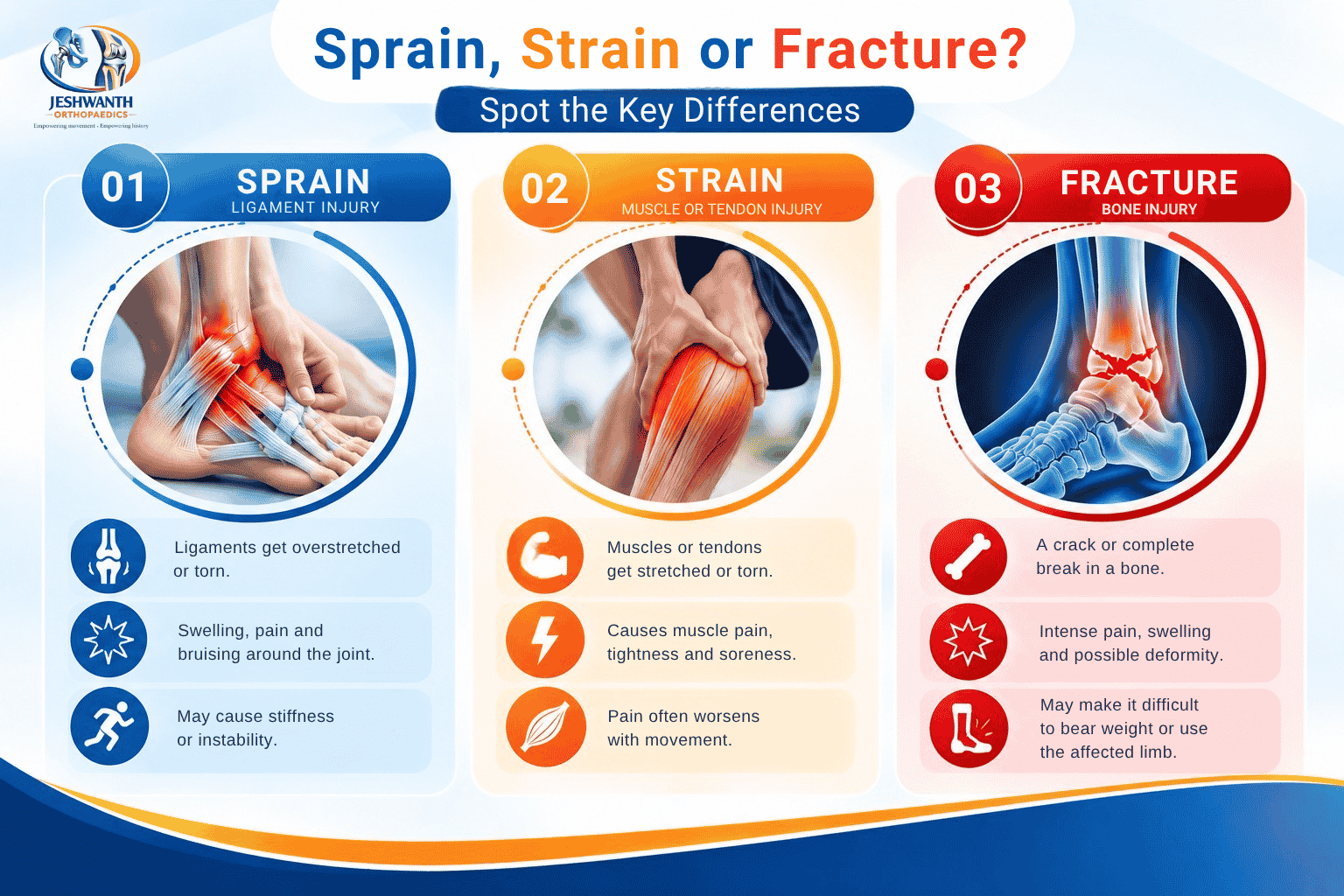
A sprain occurs when a ligament — the tough band connecting one bone to another at a joint — gets overstretched or torn. This typically happens when a joint twists beyond its normal range, such as rolling an ankle on uneven ground or wrenching a knee on a slippery bathroom tile.
Common symptoms include:
Swelling and tenderness around the affected joint
Discoloration or bruising, which may only appear the following day
A sense of instability or weakness in the joint
A mild sprain involves stretching of the ligament fibers, while a severe one means a complete tear. Depending on severity, treatment can range from bracing and physiotherapy to surgical repair.
Understanding a strain
A strain affects the muscle itself or the tendon linking it to bone. It typically occurs during physical exertion — think sprinting to catch a bus or hoisting a heavy gas cylinder.
Watch for:
Cramping or a tight, knotted feeling in the muscle
Localized soreness at a specific point
Weakness and pain triggered by stretching
If you feel a sudden pop, notice a visible indentation in the muscle, or experience an abrupt loss of strength, this could signal a complete tear — get it evaluated promptly.
Understanding a fracture
A fracture is any crack or complete break in a bone, ranging from a fine hairline crack to a full separation.
Indicators that suggest a fracture:
Intense, localized pain directly over the bone, especially when pressed
Visible deformity — the limb appears bent or misaligned
Rapid, significant swelling
Difficulty bearing weight
Numbness or a tingling sensation beyond the injury site
Two common misconceptions often delay proper care. First, people assume a broken bone means you can't walk — but that's not always true; minor fractures in the toes or feet can still bear weight for days. Second, many believe a popping or snapping sound always signals a ligament tear, when in fact broken bones can produce that same sound.
 Similar-looking injuries worth knowing about
Dislocation: the bone shifts entirely out of its joint socket. Never attempt to reposition it yourself.
Achilles tendon rupture: a sudden pop at the back of the heel, followed by difficulty pushing off while walking.
Stress fracture: a microscopic crack that develops from repetitive strain — common among runners and dancers, or in people with weak bones or low vitamin D. Initial X-rays often appear normal, so follow-up imaging like an MRI or bone scan may be needed.
Why children need special attention
Children's bones have growth plates — softer zones where the bone is still developing — that are actually more vulnerable than the surrounding ligaments. So an injury that looks like a simple sprain in a child could actually be a growth plate fracture.
Bring a child in for evaluation if they:
Experience joint pain following a fall
Start limping
Refuse to use an arm or leg normally
Left untreated, a growth plate injury can interfere with how the bone develops going forward.
Sprain vs. strain vs. fracture — a quick comparison
Treatment approaches
Sprain: rest, compression bandage or brace, followed by guided physiotherapy
Strain: brief rest period, then gradual stretching and strengthening exercises
Fracture: immobilization with a cast, splint, boot, or brace; some fractures require surgical intervention
Unsure exactly what you're dealing with? An Orthopedic Surgeon in Chennai can examine the injury, order imaging if warranted, and design a treatment plan suited to your age, occupation, and activity level.
First steps within the first 24 hours
If you suspect a sprain or strain:
Rest the injured area and elevate it above heart level
Apply a snug (not tight) elastic bandage
Use ice if it provides relief, wrapped in cloth to protect the skin
Begin gentle movement once pain allows
If you suspect a fracture:
Avoid straightening the limb — keep it in the position you found it
Stabilize it with padding above and below the injury site
Loosen any wrapping immediately if fingers or toes turn numb, cold, pale, or blue
For bleeding, apply pressure around the wound with clean cloth — never directly over a protruding bone
Things to avoid:
Oil massages or heat application in the initial days
Visiting traditional bone-setters for a suspected fracture
Testing the injury by walking or playing on it
Taking pain medication without medical or pharmacist guidance
When to seek immediate medical care
Head to the emergency room, or call 112/108 in India, right away if:
A bone is visibly exposed, the skin is broken, or there's heavy bleeding
The limb appears clearly deformed or a joint looks displaced
The hand or foot turns cold, pale, blue, or suddenly loses sensation
Pain is severe and worsening, accompanied by tight, swollen skin
There's a head, neck, or spinal injury, or the person seems disoriented — avoid moving them unless they're in immediate danger
Get evaluated soon if:
You're unable to bear weight or walk more than a few steps
The joint feels unstable, locks up, or keeps buckling
Fever develops, along with spreading redness or calf swelling
A seemingly minor injury hasn't improved after several days
Frequently Asked Questions
How can I tell if it's a sprain, strain, or fracture?
It's genuinely hard to distinguish these at home since symptoms overlap significantly. A proper medical exam, sometimes paired with an X-ray, will give you a definitive answer.
Is it possible to walk on a broken bone?
Yes, in some cases. Minor fractures in the toe or foot may still allow weight-bearing, so being able to walk doesn't rule out a break.
Can a sprain be as painful as a fracture?
Absolutely. A severe sprain can hurt just as much as a broken bone, which is why pain intensity alone isn't a reliable indicator.
How long do sprains and strains typically take to heal?
Recovery time varies with severity — mild injuries heal faster, while complete tears take considerably longer. If healing stalls, get it checked.
When is an X-ray necessary?
If there's tenderness over a bone, visible deformity, rapid swelling, or difficulty walking, an X-ray may be warranted. A doctor will make that call.
Do all fractures require a cast?
Not necessarily. Some heal adequately with rest and a supportive boot or brace, while others need surgical correction.
Why an early diagnosis matters
Most sprains and strains resolve well with basic home care. But some injuries that appear minor turn out to be more serious. A fracture mistaken for a sprain can heal improperly, and a severely torn ligament left untreated can leave a joint permanently unstable. When in doubt, get it examined. In Chennai, Dr. Jeshwanth Netaji at Jeshwanth Orthopaedics can assess your injury and walk you through the right treatment path.
Have Questions About Your Joint Health?
Get a personalized evaluation with Dr. Jeshwanth Netaji, AIIMS-trained Joint Replacement & Orthopaedic Specialist in Chrompet, Chennai.
Call +91 70100 73627 to Book